

2025/26 Steam’s record year exposes an indie crisis
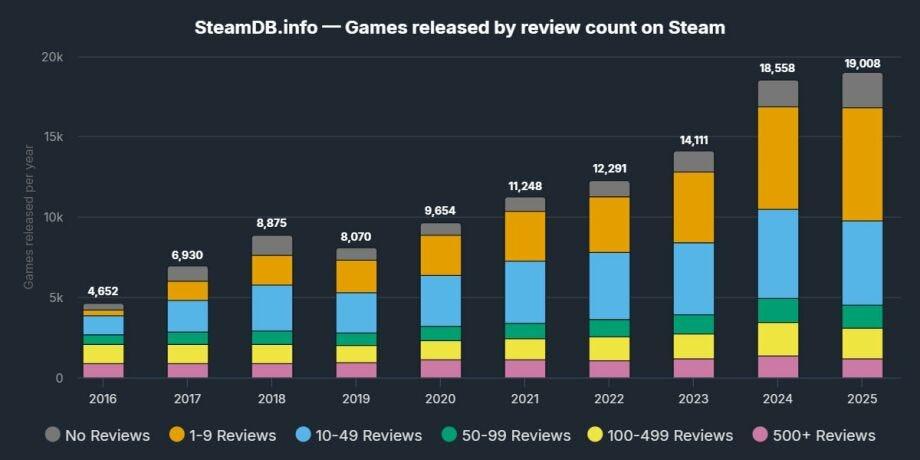
In 2025, the gaming industry reached a new milestone. Steam generated over $16 billion in revenue, reinforcing its position as the dominant distribution platform for PC games.
But beneath that growth lies a deeper structural problem.
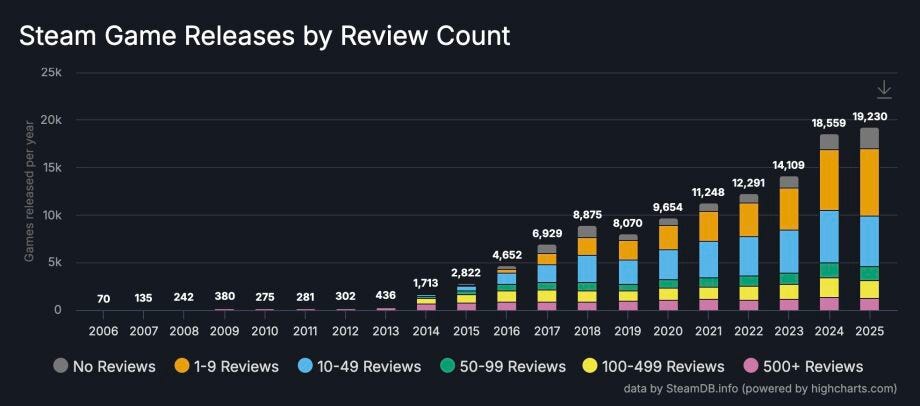
According to SteamDB data, more than 19,000 games were released in 2025, the highest number ever recorded.
And yet, nearly half of them went almost completely unnoticed.
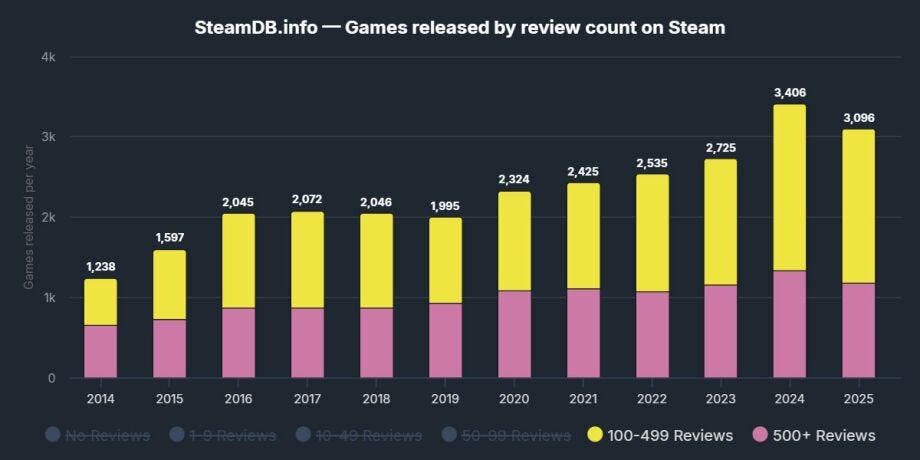
The surge in game releases on Steam in 2025 highlights a critical shift in the industry: visibility, not creation, has become the primary bottleneck for indie developers.
Out of more than 19,000 games launched on the platform, over 9,300 titles received fewer than 10 user reviews, while more than 2,200 games received no reviews at all.
This means that a significant portion of released games failed to gain even minimal player engagement, effectively disappearing shortly after launch.
Industry data suggests that:
- Approximately 40% of games do not recover Steam’s $100 publishing fee
- Around 65% of titles generate less than $1,000 in total revenue
At the same time, only a small percentage of games achieve meaningful traction. In 2025, just 608 titles surpassed 1,000 user reviews, a commonly used benchmark for visibility and commercial relevance on Steam.

Almost 20% Of Top New Sellers On Steam in 2025 Used Generative AI
The rapid increase in game releases reflects a broader shift in the development landscape driven by accessible tools and AI-powered workflows.
Modern game engines have significantly reduced technical barriers, while AI tools now enable developers to quickly generate:
- visual assets
- code snippets
- gameplay prototypes
As a result, starting a game project has never been easier. Developers can move from idea to a playable concept in a fraction of the time it previously required.
While creation has become faster, execution and completion remain complex and resource-intensive. More developers are now able to launch:
- early demos
- experimental prototypes
- first-time game projects
AI assisted projects often struggle to progress beyond the initial stages. In many cases, they are either abandoned mid-development or released prematurely as passion-driven experiments rather than commercially viable products.
The missing layer: production discipline
As the game industry evolves in 2026, a clear pattern is emerging: the primary constraint is no longer talent, tech or creativity, but production discipline.
Indie developers today have unprecedented access to tools, engines, and resources. However, many projects still struggle to make due to the absence of core production fundamentals, such as:
- structured development pipelines
- detailed task breakdowns
- clear prioritization frameworks
- defined go-to-market strategies
Every Indie Developer using this structure are making $100,000+ in revenue today.

Developers who approach their game with a production mindset operate fundamentally differently.
In contrast, developers who struggle to generate revenue often face the opposite conditions:
- feature creep and unclear scope
- inconsistent progress due to lack of prioritization
- delayed or unprepared launches
- little to no visibility strategy
Not every game will succeed, but the ones that are structured, intentional, and strategically launched have a significantly higher probability of breaking through.