

How to Find Volunteers and Collaborators for Your Game Project in 2026

Finding volunteers and collaborators for a game project sounds easy until you actually try it.
Most indie developers post a vague idea, get a few replies, open a Discord server, and then watch the whole thing stall out within two weeks. The real challenge is finding people who are aligned on scope, motivation, availability, and expectations.
In 2026, the best places to find collaborators still include communities like itch.io’s Help Wanted or Offered board, Reddit’s r/INAT, and GameDev.net’s Hobby Project Classifieds, all of which are explicitly designed for people looking to join projects or recruit teammates.
Quick Answer: How Do You Find Volunteers and Collaborators for a Game Project?
The fastest way to find volunteers and collaborators for your game project is to do three things well: define a small and believable project scope, publish a clear collaboration post in communities where game developers already look for teams, and give people enough structure to trust that your project will actually move forward.

The Best Places to Find Game Volunteers and Collaborators
1. itch.io Help Wanted or Offered

itch.io remains one of the best places to find indie game collaborators because it is already close to the culture of hobby projects, jams, experiments, and small teams.
Its Help Wanted or Offered board explicitly exists for people who need a team member or want to join a project, and the board documents common tags like LFP and LFS to make recruiting easier.
Why it works:
- Strong indie game audience
- Friendly to unpaid, hobby, and jam-style collaboration
- Good for artists, writers, composers, and beginner-friendly teams
Best for:
- Early-stage projects
- Short prototypes
- Portfolio-driven volunteers
- Finding collaborators who want experience or creative credit
2. Reddit r/INAT

r/INAT stands for “I Need A Team,” and it is one of the clearest places online for collaboration-first recruiting. The subreddit’s rules require explicit compensation framing and substantial post detail, which actually improves the quality of opportunities compared with generic “looking for devs” posts elsewhere.
Why it works:
- High intent audience
- Clear post formatting norms
- Good for both founders and people offering skills
Best for:
- Recruiting across disciplines
- Projects with a real pitch
- Teams willing to write a serious brief
3. Gamers Home
Gamers Home is a strong option for indie developers who want a place where they can start+manage a project, invite collaborators, or join someone else’s project.
The platform positions Arielle as an AI game producer for game developers and game production, and from the product flow and project interface, it is designed around helping creators organize projects, share information, and collaborate in a more structured way than a forum post or chat thread alone.
What makes Gamers Home especially useful is that it supports both sides of the collaboration journey:
- someone can register as a volunteer or collaborator and explore requests to join projects
- someone can also start their own game project, invite people in, and begin building a team around it
Why it works:
- Better project context than a simple recruitment post
- Strong fit for indie developers trying to build a team around a real roadmap
- Combines discovery with actual collaboration and project organization
Best for:
- Founders who want to recruit and manage collaborators in one place
- Volunteers looking for game projects to contribute to
- Indie teams trying to move from idea to studio-like execution
- Developers who want more structure than Reddit, Discord, or forum threads alone
4. GameDev.net Hobby Project Classifieds

GameDev.net’s hobby classifieds are still active for indie collaboration, especially for people who want more substantive discussion than quick social posts. Recent threads show people recruiting for prototypes, horror games, and small indie teams across art, code, and audio.
Why it works:
- More forum-like than feed-like
- Better for technical and long-form explanations
- More skeptical audience, which is actually useful
Best for:
- Founders who can explain vision and constraints clearly
- Recruiting developers and technically minded collaborators
- Teams willing to answer questions seriously
5. Discord game dev communities
Large Discord communities such as Game Dev League and Game Dev Network continue to function as discovery and relationship channels for developers, with public server listings showing tens of thousands of members and descriptions that explicitly mention meeting game devs, discovering projects, and finding others to build with.
Why it works:
- Real-time interaction
- Easier trust-building
- Better for ongoing networking than one-off posts
Best for:
- Meeting collaborators before recruiting them
- Finding recurring contributors
- Getting referrals instead of cold responses
6. Game jams and community events
Game jams remain one of the best ways to find collaborators because they compress trust-building into action. itch.io continues to host active game jams in 2026, and jam environments naturally attract people looking to work with others and prove they can finish something.
Why it works:
- You quickly see who actually ships
- Low-risk trial collaboration
- Great for turning short-term teamwork into long-term teams
Best for:
- Testing chemistry before inviting someone into a longer project
- Finding reliable volunteers
- Building a future studio roster
The Best Way to Attract Volunteers: Make the Scope Smaller
Most volunteers do not reject projects because they dislike the idea. They reject them because the idea sounds endless.
The easiest way to get collaborators is to recruit them into:
- a prototype
- a vertical slice
- a game jam build
- a 30-day milestone
- a one-feature demo
A narrowly scoped ask feels survivable. A giant dream project feels like unpaid indefinite labor.
If your real dream is a full studio and a commercial release, start by recruiting people into a milestone that proves momentum.
Where Arielle Fits Into This
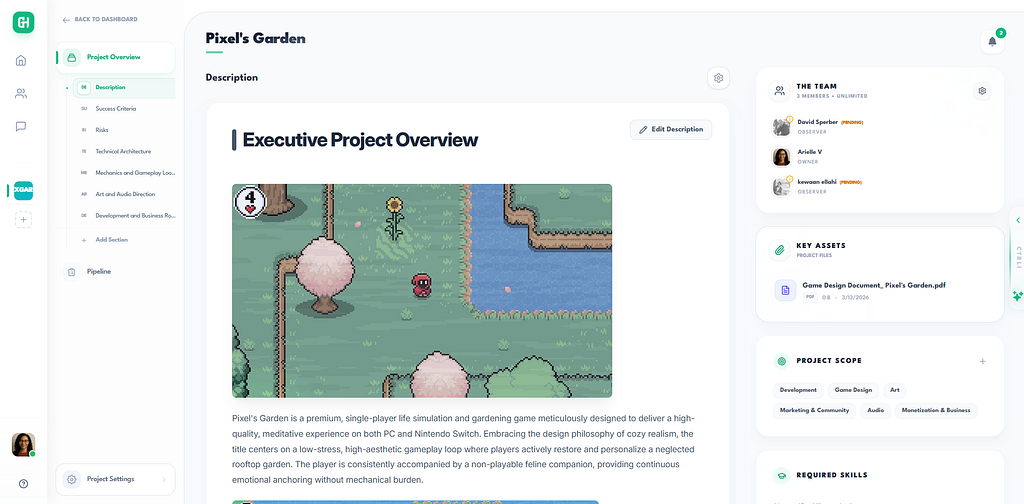
Game Project Overview
This is exactly where a platform like Arielle by Gamers Home becomes useful. One of the biggest reasons collaboration posts fail is that founders cannot show structure.
They have a game idea, but not a roadmap, role breakdown, shared project information hub, or a clear way for collaborators to understand where they fit.
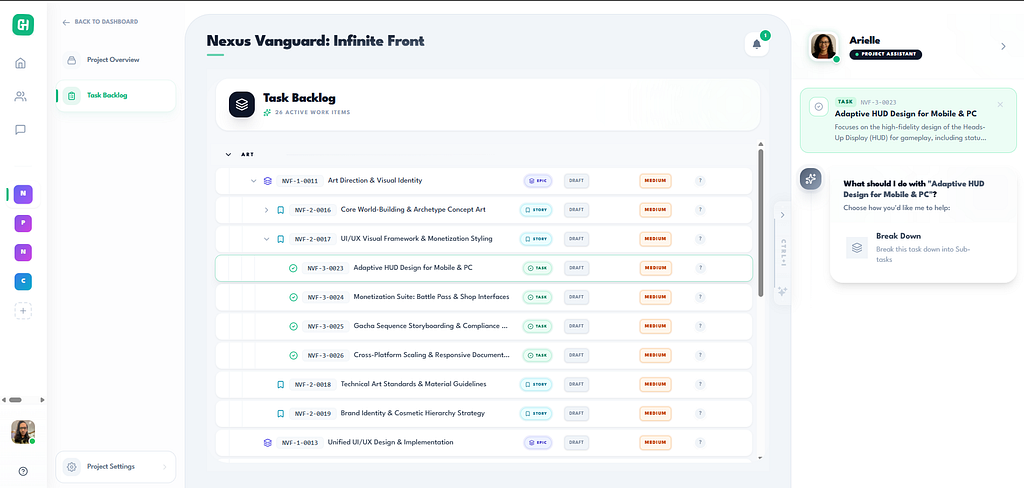
Game Development Pipeline
Instead of saying “I need help building my dream game,” you can show collaborators a clearer system: what the project is, what workstreams exist, what roles are needed, and how the team will communicate and execute.
That makes volunteer recruitment much easier because people are more likely to join a project that already feels organized.
How to Screen Collaborators Without Scaring Them Away
Once people reply, do not overcomplicate the process. You are not hiring for a AAA studio. But you should still screen for reliability.
A simple flow works best:
- Short intro conversation
- Ask what kind of projects they want to work on
- Share your milestone and expected contribution
- Review one or two examples of past work
- Start with a small test task or short-term milestone
The goal is not to “test talent” aggressively. It is to check:
- communication speed
- professionalism
- enthusiasm
- fit for the project style
- ability to finish small commitments
How to Keep Volunteers and Collaborators Engaged
Finding people is only half the problem. Keeping them is the real challenge.
Collaborators leave when:
- scope expands constantly
- the founder changes direction every week
- no one knows the next milestone
- communication lives across scattered chats and docs
- there is no visible progress
To retain volunteers, do these consistently:
- publish a weekly milestone
- make each person’s next task obvious
- celebrate completed work
- keep meetings short
- document decisions
- avoid “we’ll figure it out later” leadership
In practice, collaborators stay when your project feels like it is moving.
Common Mistakes to Avoid
Recruiting too early
If all you have is a vague concept, people will join emotionally and leave rationally. Build at least a pitch deck, reference board, or prototype first.
Recruiting too broadly
“Looking for programmers, artists, writers, marketers, musicians, and co-founders” is a red flag. It suggests no prioritization.
Overpromising rev-share
If you use rev-share, explain it cleanly and document expectations. Do not treat “future revenue” as a substitute for clarity.
Hiding project scope
People can smell an oversized project instantly. Be honest about what the first version actually is. Use Gamers Home and invite them to the development pipeline, make sure they do the tasks.
Using too many disconnected tools
If collaborators need to check Discord, Notion, Google Docs, Trello, and DMs just to understand the project, many will drop.